
Every year, data breaches expose the personal information of millions of people. While many worry about outright identity theft, there is another growing threat that stems from these leaks: highly convincing imposter scams. Armed with your name, phone number, and snippets of your financial or personal history gathered from the dark web, scammers can easily pose as trusted entities to steal your money.
When someone claiming to be from the FTC, the FBI, or your bank’s fraud department recites highly sensitive details from your credit report, it is easy to believe they are a legitimate authority. However, scammers frequently exploit personal information exposed in data breaches to manufacture this false credibility. Hearing your own private information read back to you can easily convince you to trust them. Once they have manipulated you into trusting them, they will fabricate an urgent problem that requires immediate payment, usually demanding untraceable methods like wire transfers, gift cards, or cryptocurrency.
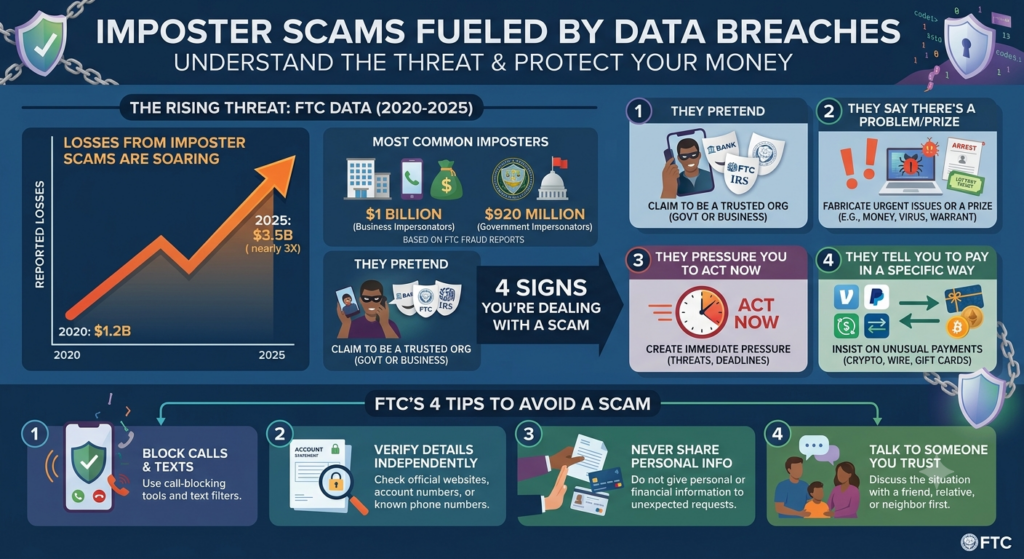
The Soaring Cost of Imposter Scams According to recent data from the Federal Trade Commission (FTC), imposter scams have reached alarming new heights. In 2025, consumers reported losing a staggering $3.5 billion to imposter scams, with total reported losses increasing nearly three times since 2020.
These scams are not just costly; they are incredibly common. FTC data shows that nearly one in three fraud reports in 2025 were about imposter scams, making it the most reported fraud category. Scammers often pose as familiar businesses (netting nearly $1 billion in 2025) or government agencies (costing consumers about $920 million). Because they often use leaked data to make their initial contact seem legitimate, victims are more easily convinced to transfer funds or empty accounts to “protect” their money.
Five Signs You’re Dealing With a Scam The FTC notes that recognizing the common tactics scammers use is your first line of defense. According to the FTC’s consumer advice, nearly all scams share four recognizable signs:
- They PRETEND to be from an organization you know: Scammers often claim to be contacting you on behalf of the government (like the FTC, IRS, or Medicare) or a recognizable business (like a utility provider, a tech company, or your bank). They frequently spoof caller ID numbers to make their calls look official.
- They say there’s a PROBLEM, PRIZE or DISCOUNT: To grab your attention, they will claim you are in trouble, owe money, or that there is a virus on your device. Conversely, they might claim you’ve won a sweepstakes but need to pay a fee to claim your prize. Or perhaps they claim to be your internet service provider offering a large discount for a fee.
- They PRESSURE you to act immediately: Scammers want you to panic and act before you have time to think critically. They may threaten arrest, deportation, or a compromised bank account if you don’t stay on the phone and do exactly as they say right that second.
- They tell you not to tell anyone: Scammers don’t want you to tell anyone about the “problem” – including loved ones, friends, bank representatives, etc. They fear that someone else will convince you that you’re involved in a scam.
- They tell you to PAY in a specific way: A massive red flag is how they ask for money. Imposters will insist you pay using gift cards, cash deposited into cryptocurrency ATMs, Zelle or a direct transfer out of your bank/investment account.
How to Protect Yourself and Avoid Scams Even if an email or caller seems to know specific details about you—information they likely purchased after a data breach—you can protect yourself by following the FTC’s recommended steps:
- Report scam calls and text messages: Use call-blocking tools and text filters to reduce the number of scam attempts that reach your phone.
- Never give your personal or financial information to unexpected requests: Honest organizations will not call, email, or text out of the blue asking for your Social Security number, bank account details, or credit card numbers.
- Verify links and phone numbers independently: If you get an alert from a company you do business with, don’t click the link provided. Instead, manually go to the company’s official website or call the number listed on your account statement to verify if the alert is real.
- Resist the pressure to act immediately: Legitimate businesses and government agencies will always give you time to make a decision. Anyone demanding immediate payment or information is a scammer.
- Talk to someone you trust: Before taking any action or sending money, pause and tell a friend, family member, or neighbor about the situation. Simply explaining it out loud can often help you realize it’s a scam.
If you suspect you’ve encountered a scam, you can help the authorities track down these imposters by reporting it directly to the FTC at ReportFraud.ftc.gov.