
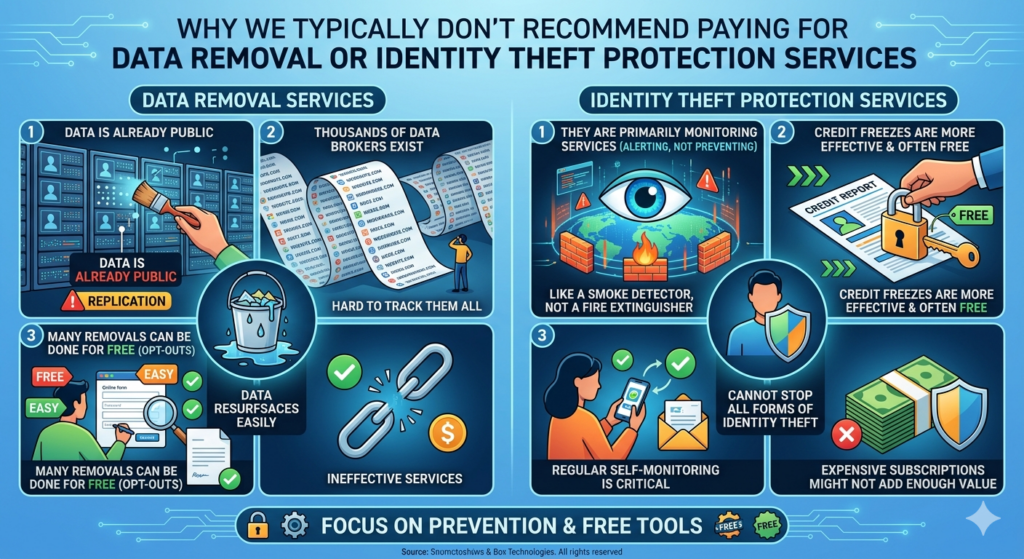
- Subscription limits and structural barriers: Data removal services cannot completely delete your information from the internet due to insurmountable legal and structural barriers, such as criminal-run dark web marketplaces that ignore deletion requests and government public records (like property deeds and court records) that are exempt from privacy laws.
- The “Whack-a-Mole” subscription trap: Automated removal tools face resistance from data brokers requiring manual identity verification, and because brokers constantly re-scrape the web for new data, your information will likely reappear within 6 to 12 months if you stop paying for the recurring subscription.
- Proactive alternatives and damage control: These services should be viewed as minor damage control for reducing spam rather than a total digital reset; for true identity protection, the article recommends utilizing Google’s free “Results about you” tool to de-index sensitive search results and placing a cost-free freeze on your credit report.
The privacy landscape of 2026 offers a range of tools – from the specialized scrubbing of Incogni, DeleteMe, and Optery to the broad-spectrum security of Aura and LifeLock. However, a critical misunderstanding persists: the belief that a subscription can “delete” you from the internet entirely.
You may have seen advertisements from these services, or even a recommendation from a technology personality. That recommendation is often because they are getting paid by the sponsor. But we at Computer Techs have a different opinion of these services.
While these services may help at reducing your online visibility, they face structural and legal barriers that make total removal an impossibility.
1. The Dark Web: Information Without an “Admin”
The most common marketing misconception is that these services can “remove” your data from the dark web. They cannot.
- No Authority to Contact: Unlike a legitimate data broker, dark web marketplaces are run by criminal entities. There is no “customer service” department or legal “opt-out” form to submit.
- Instant Replication: Once a database of emails or passwords is leaked, it is copied, downloaded, and re-uploaded across hundreds of encrypted servers. Even if one site is shut down, the data persists in private chat channels and offline archives.
- The Reality: Services like Aura and LifeLock provide Dark Web Monitoring, which is essentially a smoke alarm. They can tell you that your data is there, but they have no “fire extinguisher” to put it out.
2. The Government and Public Record Wall
Data removal services operate under consumer privacy laws (like the CCPA or GDPR), but these laws generally do not apply to government-mandated public records.
- Untouchable Data: Information found in court records, property deeds, marriage licenses, and voter registrations is part of the public record.
- The Loophole: Data brokers like Whitepages often “scrape” this government data. While a service like DeleteMe can get the broker to hide the listing, they cannot force the county clerk to delete the original source. Your information remains accessible to anyone willing to go directly to the government source.
3. Automation vs. The “Human” Hurdle
Automated tools like Incogni send requests at a massive scale, which is efficient but has a ceiling.
- Manual Resistance: Some brokers intentionally require manual “proof of identity” (like a photo of an ID) or even notarized letters to process a deletion.
- The Drawback: Most automated bots cannot navigate these hurdles. They may mark a request as “sent” or “pending” indefinitely, whereas a service like Optery or DeleteMe might use human intervention to push through, though even they cannot guarantee a response from a hostile broker.
4. The Verification Gap
Most services operate on a “trust us” model. You see a dashboard with green checkmarks, but rarely any proof of deletion.
- Suppression vs. Deletion: A broker may “suppress” your info (hide it from search) rather than delete it.
- The Optery Difference: Optery is one of the few that provides actual screenshots of the search results before and after, but for the majority of the industry, you are paying for the attempt at removal rather than a verified result.
5. The Subscription Trap
Data removal is not a one-time event; it is a recurring utility.
- The “Whack-a-Mole” Effect: Brokers constantly re-scrape the web. The moment you purchase and register a new car, buy new property or sign up for a new mortgage, your data is back in the ecosystem.
- The Result: If you stop paying for subscription removal services, the monitoring stops. Within 6 to 12 months, your profile will likely be rebuilt by the same brokers you just paid to leave.
6. The Hidden Risk of Identity Protection Services
Think about how we protect our homes. We lock the front door, maybe put up a security camera, and try to keep our private lives private. But online, things are a lot messy. Data brokers and cybercriminals are constantly buying, selling and stealing our personal information—like where we live, our phone numbers, and our past addresses.
To fight back, you may be considering signing up for identity theft protection or data removal services. These companies promise to scrub our information off the internet and watch out for scammers. But there is a giant catch: to help you, these services need you to hand over your most private keys. You have to give them your full name, your birthday, your Social Security number, your driver’s license number and more. You are putting all your most important eggs into one single basket, trusting that their digital vault is completely unbreakable.
But what happens if a hacker breaks into that vault?
If one of these protective services gets breached, it is a total disaster. Instead of a scammer having to dig through a hundred different websites to piece together your information, the hacker now has a perfectly organized, one-stop shop with everything they need to steal your identity or pose as your banker or government official. The very company you paid to keep you safe has accidentally made you a much bigger target. It leaves us with a tough question: is it really safer to trust one big company with all our secrets, or are we just trading one digital headache for a much bigger one? It’s happened already to services such as Aura (2026), Equifax (2017) and Experian (multiple documented vulnerabilities).
A free option: Removing your data from Google searches
While third-party services like Incogni or DeleteMe focus on the data brokers themselves, you can also take direct action through Google’s own “Results about you” tool. This feature allows you to proactively monitor and request the removal of search results that contain sensitive personal information, such as your home address, phone number, and as of 2026, government-issued IDs like your Social Security number or passport. However, it is vital to remember that removing a link from Google is de-indexing, not deletion; the information remains on the original website and in the public record. For a truly effective strategy, Google’s internal tools should be used in tandem with broader data-scrubbing services to ensure information is being attacked both at the search level and at the source.
Final Verdict
If you’re worried about public information being used to steal your identity and possibly damage your credit, placing a freeze on your credit report is a good cost-free option. Read: The Anxiety of Data Breaches and Dark Web PII Exposure: What You Can and Cannot Do.
In 2026, data removal services are best viewed as damage control, not a digital reset. They may help reduce a small amount of spam and marketing emails, calls and texts – and make it harder for “people-search” sites to list your home address or phone number, but they cannot erase the permanent “residue” of the dark web or official public records.
If you’re a high-profile public figure, these services may help limit the amount of personal information available to would-be stalkers. But for the average person, there’s still enough information that continues to be leaked in data breaches and re-circulated on the dark web for imposter and social engineering scammers to be able to have enough information about you to coerce you into falling for their tricks. Remain informed about scams, stay on guard and stay safe!