AVG Anti-Virus Free 2011 was released September 28th. A review by CNET indicates that it’s better than previous versions. I’ve noticed that AVG Identity Protection and Anti-Rootkit components are now included in the free version. This should improve detection over the previous version.
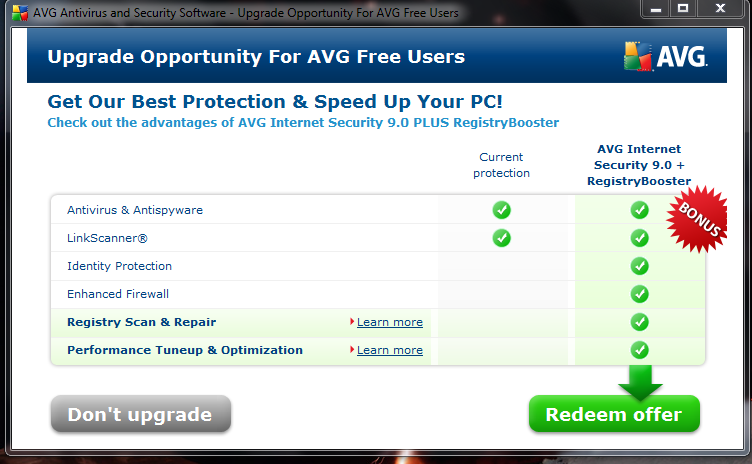
If you currently have AVG 9.0 or earlier you will likely see a prompt to update similar to the window shown below. I suggest selecting “Update your free protection” or “Basic Update”. The not-free Internet Security program adds redundant and unnecessary extra protection that usually slows down computers and presents confusing firewall prompts.
After visiting the AVG website and downloading the free version…
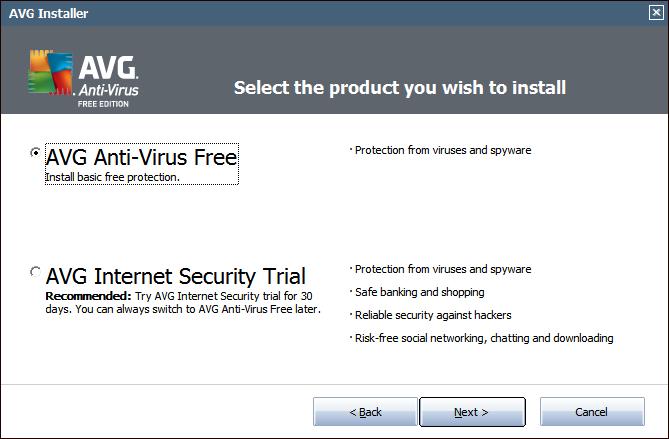
…if prompted to install the AVG/Yahoo! Browser Toolbar and change your default search engine, un-check the 2 boxes (the bottom then the top), then proceed with installing AVG without the toolbar (as shown below).
I recommend ignoring the PC Analyzer component. It looks for registry errors and junk files among other things – which are harmless – then prompts you to buy the add-on if you want items fixed.
If you need assistance downloading and installing the new AVG Anti-Virus, please call or e-mail us. We’ll be happy to take care of it for you, and give your computer a check-up/tune-up while we are there.
Picasa is Google’s free and easy-to-use photo transfer and management program. The latest version includes features such as face recognition and grouping by person, photo retouching tools, movie and slideshow creation, and easy upload to Google’s free Picasa Web Albums or Google+ Photos.
Picasa can take the place of photo management software that comes with digital cameras and printers, allowing you to transfer photos from your camera or card reader into custom-named folders on your computer. A frequent problem that we see on people’s computers is multiple photo managements programs that are “fighting” to take control of transferring and displaying pictures from a camera.
Picasa also allows you to view all the photos on your computer on one screen without having to click in-and-out of folders to find and view them. The software also offers photo manipulation tools such as cropping, brightness adjustment, red-eye removal and blemish retouching. There are also several printing options that let you print pictures in many sizes and multiple pictures per page. It will also downsize photos for emailing or for uploading to your personal Picasa Web Albums website.
Some of my favorite Picasa features include:
Automatic picture downsizing when sending photos via e-mail
E-mailing photos directly from Picasa will launch your email client (such as Outlook or Windows Live Mail). If you don’t use an email client, you can create a free Google email address and send photos from your Gmail account.
Upload individual photos or entire albums to Google+ Photos or Picasa Web Albums, set privacy settings, and share your photos with friends and family. Google+ Auto Backup gives up to 15GB or unlimited free online storage depending on the picture size that is backed up online.
Friends and family don’t need to sign-up for anything to be able to view your photos, and they can download full-size copies at no charge (assuming you have allowed that freedom in the privacy settings you set).
Create a video slideshow of your photos, adding transitions, text and music.
Easy backup to CD or DVD options, or create a “gift CD” which can be sent to someone to play on their computer.
Easily send your photos to online services to have your pictures printed.
Watch the short video below for more information about Picasa 3. To view all of Picasa’s features and download it, visit their website to view a complete details. If you need help or would like to schedule private tutoring on how to transfer, manage, edit, share, print, and backup your photos with Picasa, give us a call.
If your hard drive crashes and you don’t have a backup of your pictures, documents, music, email, financial data, etc., data recovery services can attempt to recover your data at a cost of $500-$1000 or more. Or, for less than $6 per month – and in some cases for free – your data can be backed up automatically to a safe off-site location.
In previous articles I’ve discussed loss of personal data due to inevitable hard drive failure, computer theft or damage by fire, and methods of backup including: to CDs, flash drives and external hard drives. With normal wear-and-tear the general life span of a hard drive is approximately 5 years.
Our preferred backup method is now online automatic backup from services such as Carbonite. Online backup offers secure encrypted transfer and storage of your data (pictures, documents, music, email, etc.) that automatically backs up your important files on a daily basis.
Shopping for a new computer can present people with confusing choices. Frequently I research the best deals on new PCs from local retailers and publish my findings. If you’d like to receive an e-mail from Computer Techs about the best deals on recommended computers from local retailers, click here and sign-up for our “new computer deals” newsletter. You can view our most current newsletter at newpc.CTreno.com.
Whether you take our advice or want to shop on your own, below are some tips to help you select a new PC and get the best deal:
• Don’t spend more for a faster speed of the same processor. For example, if a store is charging $100 to upgrade from a 2.8Ghz processor to 3.0Ghz – the extra money does not justify the small increase in performance difference.
• Don’t spend extra for a larger capacity hard drive unless you plan on editing & storing video files.
• Laptop, Netbook or desktop? If you need portability or don’t have the room for a desktop PC, consider a laptop. Laptops generally come with screen sizes of 11″-17″. They are nearly as quick and powerful as desktop computers these days. If considering a laptop, test it thoroughly in a store before purchasing – test keyboard and touchpad usability and comfort, and look at screen clarity. You may even want to consider getting a tablet computing device.
• Many major electronic and office supply stores offer tech services that will tune-up and customize your new computer by removing unnecessary trial software, etc. Computer Techs offers more complete service including in-home setup of your new computer, connecting your internet/home network, printer, and other devices, transferring your files and installing programs to your new PC – all at a better value than offered elsewhere.
• I don’t recommend buying an extended warranty. Stores make a huge profit-margin on extended warranties, and the sales people usually make big commissions to push them. Extended warranties often only cover hardware repairs after the manufacturer’s warranty has run out. Only about 10 percent of our service calls involve hardware repairs – so repairs that would be covered by an extended warranty are rare.
• If you’re purchasing a new printer or other device that needs a USB cable, many stores mark-up the cable’s price by a few hundred percent. You can purchase a 15-foot USB cable for a printer from Computer Techs for approximately $15. If you’re replacing a printer, you can likely use the cable from your old printer.
• If the thought of going to the store, fighting the crowds, salespeople and choices overwhelm you – then don’t do it. For a nominal fee, we will purchase your new computer equipment for you, set it up in your home, and teach you how to use it.
After seeing the popularity of Apple’s iPad tablet computer which was released earlier this year, manufacturers have been scurrying to release many new tablets to compete with the iPad and Amazon’s Kindle e-reader. By this holiday season there should be many tablet computers to choose from, at minimum most featuring the ability to read books and go to internet web pages on-the-go. More advanced devices will stream video, let you write documents, and just about everything that a regular computer can do – all on a 7-10″ portable touch-screen device. Tablet computers have come a long way since the days of the Palm Pilot.
Some advantages of getting a tablet computer to supplement your desktop computer include:
• Instant-on: You rarely need to turn-off a tablet computer since they don’t make noise or use the energy of a desktop computer. When you want to start using a tablet you simply press a button to bring it out of a stand-by power state, and it’s ready to use.
• Portable: With most tablets running from 7-10″ screen sizes, they are very portable and light-weight – some lighter than the popular netbook computers of last holiday season which feature a physical keyboard and no touch-screen. Most tablets have built-in wi-fi radios which let them connect to the internet via wi-fi hotspots which are common in the home, coffee shops, restaurants and airports. Some tablets also include a 3G cellular radio which let them connect to the internet via cell sites with monthly service plans provided by AT&T, Verizon, Sprint, T-Mobile, etc.
• A back-up computer: Tablet computers have become very powerful and cost effective to use as a back-up computer should your main desktop computer fail. With a tablet computer you can still use e-mail and the internet, and do on-line banking while you wait for your Computer Technician to arrive.
• Apps and fun: Because of the smaller screen size than desktop computers, developers have designed apps (aka applications) that utilize the smaller screen size to show web content, games and utilities. Many newspapers are moving towards delivery of their media via tablet apps, as are books. There are tens-of-thousands useful apps for just about anything you could think of doing on a portable computer.
Tablet computers also let you send and receive e-mail, store contact information, play music and video and view photo albums. Some devices even let you take pictures and video, and use it as a large screen GPS device.
For reviews of tablet computers, click to visit the following web sites:
AT&T has recently sent emails stating that if you still use the AT&T Yahoo! Browser, you should switch to using Internet Explorer, Firefox or other web browser of your choice by October 1.
Wi-fi routers and modems allow you to share your high-speed internet connection with multiple computers or wireless devices throughout your home. Though convenient, most wi-fi routers have security risks if not configured differently from the default out-of-the-box settings. Below are the first 3 things that Computer Techs professionals do to secure a newly installed wireless router:
1. Set-up WPA wireless encryption: Wireless encryption effectively “scrambles” the wireless radio signals between your router and wireless devices so that only devices that have the wireless encryption key can communicate with it. There are 2 standard encryption methods – WEP and WPA – we use the more secure WPA method whenever possible.
2. Changing the default SSID: The SSID is the name of your network that is broadcast that other people with wireless devices can see. We change the SSID to a name that is recognizable by you, but not necessarily by others within range of your wireless network. The typical range of a wi-fi wireless network is a few hundred feet.
3. Changing the router’s administrator/management password: The administrator/management password should be changed to help prevent unauthorized changes to the settings of your wireless router. Unauthorized changes could lock you out of your wireless router and network. Also computer malware can now change router settings to direct your internet browsing to fake web sites.
If securing your wireless router looks a bit confusing, give us a call so that a Computer Techs expert can properly secure your wireless router for you.
An advertisement pop-up from AVG Anti-Virus Free Edition has recently begun promoting an offer to upgrade to a paid version with more features. In my opinion most people don’t need the additional features that AVG Internet Security provides since most of the additional features are redundant or free from other sources. The upgraded program also has more components of AVG that run in the background, thus slowing down the computer. Specific examples of the additional modules included in AVG Internet Security are listed below:
Firewall: The Windows firewall already on your PC is sufficient and doesn’t pop-up an alert for every unknown program attempting to make an internet connection. Also, routers and some broadband modems provide more secure hardware firewall protection.
Web Shield: You can avoid viruses by not clicking on unknown links or files in Instant Messaging programs web sites.
Anti-Rootkit: AVG Free detects some rootkits
Anti-Spam: Anti-spam programs don’t work with AOL, Yahoo and other web mail services. If you use a mail program like Outlook or Windows (Live) Mail, their protection is likely no better than the junk email filters included with those programs.
Identity theft protection: Though the name of this protection is somewhat vague, this is the only extra protection I would recommend for some people. This protection “uses a technology called behavioral analysis to make sure all the programs running on your computer are operating the way they should. If it spots something suspicious that could indicate an attempted ID theft attack, it shuts that activity down, preventing any possible theft from happening”. This protection is also available as a $19.99 annual upgrade to AVG Free, or any other security product. You can also install a similar free product called ThreatFire.



 Print This Article